N9K-C93180YC-FX3
25G SFP28 leaf / ToR shortlist.

Compared products: N9K-C93180YC-FX3,N9K-C93600CD-GX
Exact-PID comparison for data-center leaf shortlists. Higher fabric speed does not make GX an automatic drop-in for an FX3 leaf.
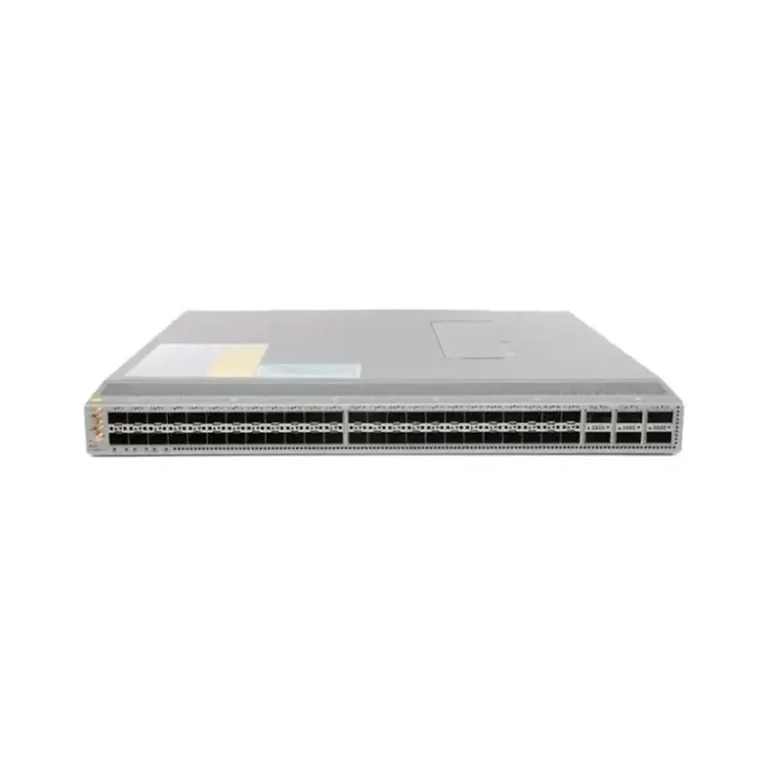
48 × 1/10/25G SFP28 + 6 × 40/100G QSFP28
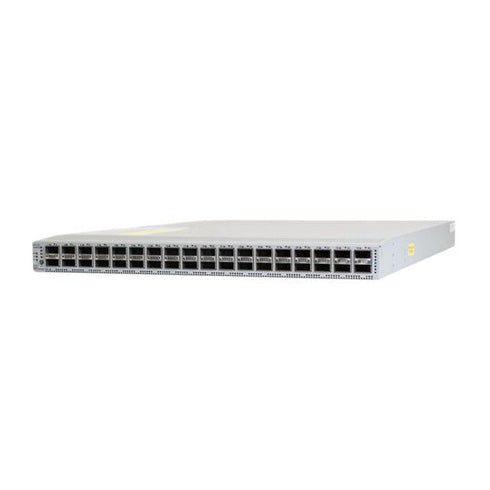
28 × 40/100G QSFP28 + 8 × 40/100/400G QSFP-DD
| Attribute | N9K-C93180YC-FX3 | N9K-C93600CD-GX |
|---|---|---|
| Exact PID | N9K-C93180YC-FX3 | N9K-C93600CD-GX |
| Hardware role | Fixed leaf / ToR (SFP28 edge) | Fixed leaf / compact spine-capable GX |
| Server-facing ports | 48 × 1/10/25G SFP28 | 28 × 40/100G QSFP28 |
| Fabric-facing ports | 6 × 40/100G QSFP28 | 8 × 40/100/400G QSFP-DD |
| Management | OOB (not business ports) | 1 × copper + 1 × SFP OOB (not business ports) |
| Switching bandwidth | 3.6 Tbps full-duplex | 12 Tbps |
| Forwarding | 1.2 Bpps | 4.0 Bpps |
| Software mode | NX-OS / ACI | NX-OS / ACI |
| Form factor | 1 RU fixed | 1 RU fixed |
| PoE | Non-PoE | Non-PoE |
Migration note: Moving from FX3 to GX is an optic-class and oversubscription redesign, not a cable swap.
GX breakout is port-group dependent. Cisco documentation describes quad grouping on ports 1–24 and odd/even limitations for some 4× breakouts; QSFP-DD ports 29–36 have separate profile/breakout notes, and ACI mode can reserve certain ports as fabric links. Plan optics against the HIG for your software train.
FX3 planning stays in the SFP28 + QSFP28 ecosystem. Do not assume FX3 MACsec/timing features transfer unchanged to GX.
No. Different optic technologies and faceplates. They are not interchangeable by swapping optics alone.
N9K-C93600CD-GX lists 12 Tbps vs 3.6 Tbps on N9K-C93180YC-FX3 in Cisco’s published materials for these models.
No. Management copper/SFP ports are separate from business QSFP ports.
No. Follow OEM port-group and odd/even restrictions for your release — do not assume universal free breakout.
25G SFP28 leaf / ToR shortlist.
100G/400G GX leaf shortlist.
Full 12-step procurement workflow.
Buying guide · Procurement analysis