
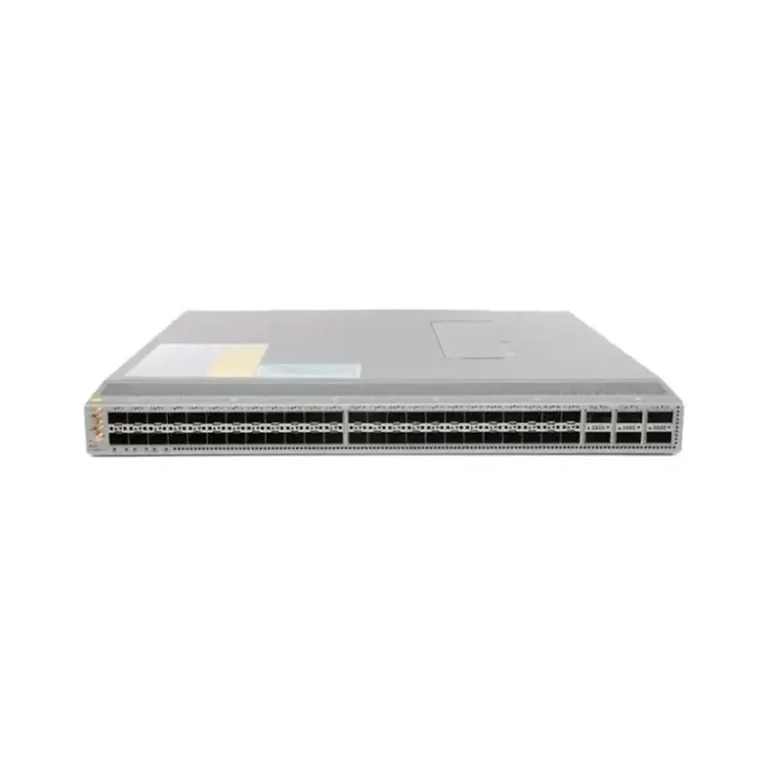
48 × 1/10/25G SFP28 + 6 × 40/100G QSFP28
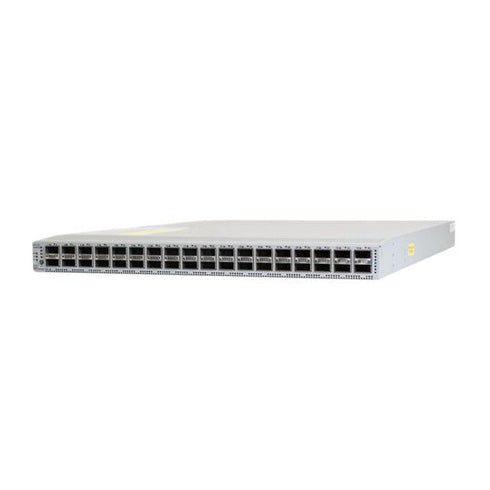
28 × 40/100G QSFP28 + 8 × 40/100/400G QSFP-DD
Scope: fixed Cisco Nexus 9300 leaf platforms where the open decision is 25G SFP28 FX3 versus 100G/400G GX. Campus PoE, PoF hybrid cable, and modular Nexus 9500 chassis are out of scope.
12-step procurement workflow
- Server/storage port speeds — lock SFP28 25G vs QSFP28 100G before naming a PID.
- Port quantity and growth — count today plus 12–24 month attach growth.
- Leaf / spine / fabric role — ToR leaf, compact spine, or ACI leaf/spine intent.
- Optics and reach — SR/LR/DR/FR families and fiber plant constraints.
- 100G and 400G requirements — whether QSFP-DD is required or QSFP28 uplinks suffice.
- Breakout and port-group limits — especially GX quads and odd/even rules (see below).
- Software mode and release — NX-OS vs ACI; confirm features on the target train.
- Bandwidth / oversubscription — leaf-to-spine ratio against OEM capacity class.
- Airflow, PSU, redundancy — PI/PE fans, dual supplies, sparing.
- Rack and power — 1RU depth, PDU budget, thermal adjacency.
- Exact-PID shortlist — FX3 vs GX only after steps 1–10.
- Detailed RFQ — PID, optics BOM, mode, airflow, PSU, quantity, docs.
Architecture considerations
- SFP28 server edge → start with N9K-C93180YC-FX3.
- QSFP28/QSFP-DD 100G–400G edge → start with N9K-C93600CD-GX.
- Management copper/SFP ports are out-of-band — never business ports.
Verified comparison matrix
| Item | N9K-C93180YC-FX3 | N9K-C93600CD-GX |
|---|---|---|
| Business ports | 48 × SFP28 + 6 × QSFP28 | 28 × QSFP28 + 8 × QSFP-DD |
| Primary edge speed | 1/10/25G | 40/100G (400G on QSFP-DD) |
| Bandwidth (OEM listing) | 3.6 Tbps full-duplex | 12 Tbps |
| Forwarding (OEM listing) | 1.2 Bpps | 4.0 Bpps |
| PoE | Non-PoE | Non-PoE |
| Mode | NX-OS / ACI | NX-OS / ACI |
| Breakout caution | Confirm FX3 optic/breakout notes for release | Quad/odd-even limits on ports 1–24; ACI fabric reservations on some QSFP-DD |
GX breakout rules buyers must not oversimplify
Cisco N93600CD-GX hardware documentation describes grouping behavior on ports 1–24 (often discussed as quads) and restrictions where certain 4×10G / 4×25G breakouts apply on odd ports with paired even ports becoming inactive. Ports 25–28 and 29–36 have their own breakout/profile notes. Do not plan as if every QSFP port freely breaks out to any speed. Validate against the HIG and the exact NX-OS/ACI release before purchasing optics.
Shortlisting logic
- Choose FX3 when most attach is SFP28 and six 100G uplinks meet fabric math.
- Choose GX when attach is QSFP28 100G and QSFP-DD 100/400G fabric options are required.
- Choose neither for campus PoE/PoF copper-hybrid designs or when a modular 9500 chassis is required.
Buying-guide FAQs
Can GX replace FX3 with breakout adapters alone?
Usually no. QSA/adapters may expose limited lower speeds in some designs, but GX is not a drop-in for a 48× SFP28 leaf. Redesign optic class and oversubscription together.
Why reject some reseller “96×SFP28” text for 93600CD-GX?
Cisco OEM documents define 28×QSFP28 + 8×QSFP-DD. Treat pasted SFP28 maps as identity errors.
Does higher Tbps always mean buy GX?
No. If servers are SFP28, unused QSFP28 density does not fix the attach problem.
What about airflow and PSUs?
Confirm port-side intake vs exhaust and dual-supply intent on the RFQ. Mixing airflow directions in a row is a common install failure.
Related: procurement blog · exact-PID comparison · N9K-C93600CD-GX · N9K-C93180YC-FX3 · Request a quote