
This buying guide is for procurement and network design teams shortlisting data-center leaf / TOR switches. It focuses on role, faceplate, capacity, optics, and RFQ inputs—not brochure slogans.
Campus PoE access SKUs belong on a different shortlist. If your request is powered copper for APs and phones, start with PoE Switches or the article Campus PoE vs Data Center Leaf.
Leaf / TOR role in a leaf–spine design
In a leaf–spine fabric, leaf (often top-of-rack) switches connect servers southbound and connect to spines northbound. Selection is driven by server NIC speed, fabric uplink speed, oversubscription target, and optic plan. Closet stacking features and PoE budgets are not the primary scorecard.
Example models on this shortlist
These three PIDs are the worked examples. The grounded comparison table is further down — faceplates stay on the product record, not on this diagram.
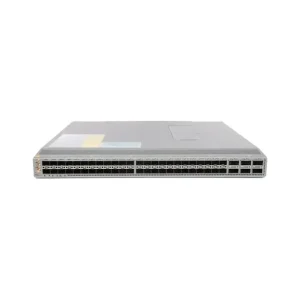 N9K-C93180YC-FX3
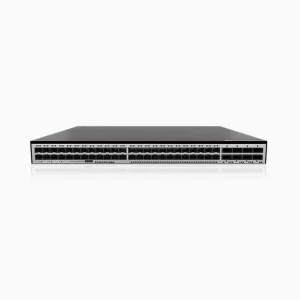 CE6855-48XS8CQ
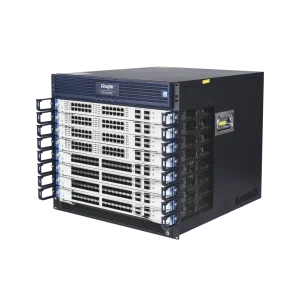 RG-S7810C
Connectivity
Server-facing port speed
Match the leaf downlink to the server NIC generation you are deploying now—and the one you expect within the refresh window. Mixed 1/10/25G SFP28 faces are common on modern leaves; older 10G-only SFP+ leaves still fit many 10G server estates.
Uplink / fabric speed
Northbound ports must sustain the east–west and north–south traffic your oversubscription math allows. Many leaf SKUs use QSFP28 for 40/100G fabric links. Confirm breakout needs (if any) before ordering optics.
Port density
Port count is not capacity. A 48-port leaf with thin uplinks can bottleneck before a lower-density leaf with balanced fabric links. Count usable server ports after reserving ports for dual-homing, storage, or out-of-band if those share the same faceplate.
Fabric planning
Switching capacity and forwarding rate
Use the capacity and forwarding figures on the product record as planning inputs, then validate against your fabric math. Prefer consistent units when comparing vendors, and treat “up to” chassis figures as configuration-dependent.
Oversubscription considerations
Oversubscription is a design choice, not a SKU feature. Document the intended ratio (server bandwidth vs fabric bandwidth), dual-homing, and whether spines are shared across pods. Ask vendors to quote optics and cables that match that plan—not a generic “100G uplink” line item.
Optics / transceiver planning
Leaf RFQs stall when optics are missing. Specify:
- Server optic or DAC/AOC type and reach
- Fabric optic type (SR4/LR4/etc.) and fiber plant
- Breakout vs native QSFP use
- Any third-party optic policy
Operations
Redundancy considerations
Plan dual-home servers (two leaves), redundant PSUs where the platform supports them, and spine diversity. Do not assume chassis-style supervisor redundancy exists on a fixed leaf.
Cooling / airflow
Only call out airflow when the product record states it. Example: CE6855-48XS8CQ lists front intake with optional reverse. Hot-/cold-aisle orientation should match the SKU airflow; confirm before ordering opposite-airflow variants.
Power and rack considerations
Note PSU type/wattage from the listing, rack depth, and cable management for dense optic faces. Leaf rows often care more about optic density and airflow than about PoE headroom.
Campus access vs leaf distinction
Do not evaluate Catalyst 9300 PoE, Ruijie Multi-GE PoE, or H3C PoE access models as leaf substitutes. Those remain on access / PoE shortlists. See also C9300-24P vs C9300-48P-A for closet density choices.
Example shortlist (grounded fields only)
| Model | Server-facing (listing) | Fabric / uplink (listing) | Switching capacity | Forwarding rate | PoE |
|---|---|---|---|---|---|
| N9K-C93180YC-FX3 | 48 × 1/10/25G SFP28 | 6 × 40/100G QSFP28 | 3.6 Tbps full-duplex | 1.2 Bpps | Non-PoE |
| CE6855-48XS8CQ | 48 × SFP+ | 8 × QSFP28 | 2.56 Tbps | 1,200 Mpps | Non-PoE |
| RG-S7810C | Confirm module / faceplate on RFQ (listing capacity is chassis-class) | Up to 16 Tbps | Up to 12,000 Mpps | Confirm on RFQ | |
Fields above are taken from the QianliSwitch product records for these PIDs. Where a faceplate is configuration-dependent, the table says so instead of inventing ports.
Questions to answer before requesting a quote
- What server NIC speeds are in scope for this leaf generation?
- What fabric uplink speed and optic type will connect to spines?
- What oversubscription target is approved for this pod?
- How many usable server ports per leaf after dual-homing?
- Any airflow orientation constraint in the rack row?
- Which optics/DACs must be quoted with the switch?
- Is this definitely a leaf role—not campus PoE access or campus core?