Use this guide when campus aggregation is optical fiber on Catalyst 3850 and you must choose between 10G SFP+ density and 1G SFP density. It is a procurement guide for fiber aggregation PIDs — not a PoE closet catalog and not a data-center leaf shortlist.
For fixed 100G/400G data-center spines, use the 100G fixed switch guide instead.
What this guide covers
| Topic | In this guide? | Notes |
|---|---|---|
| Fiber aggregation (optical southbound) | Yes | Catalyst 3850 SFP / SFP+ aggregation PIDs |
| Copper PoE access closets | No | Use a PoE access PID / PoE guide |
| Data-center leaf / 100G spine | No | Use leaf or 100G fixed guides |
Fiber aggregation role
In a typical campus design:
- Access closets terminate user or AP links (often copper PoE — outside this guide).
- Aggregation / distribution consolidates many access uplinks — this is where optical Catalyst 3850 fiber models usually sit.
- Upstream / core takes fewer, higher-capacity links toward the campus core or WAN edge.
If the line item is powering phones and APs, you are in the wrong guide. If the line item aggregates optical access uplinks, continue.
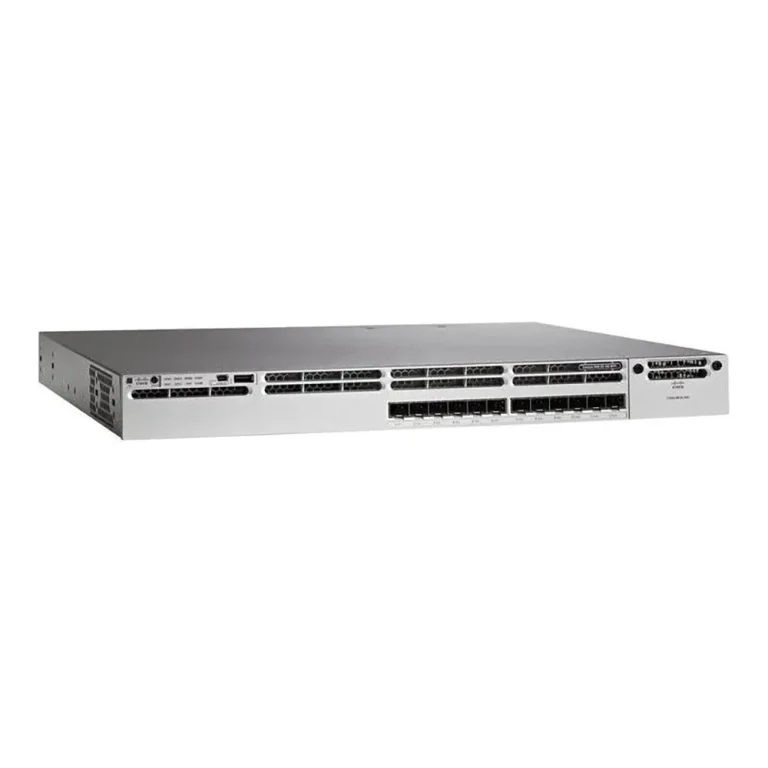 WS-C3850-12XS-E
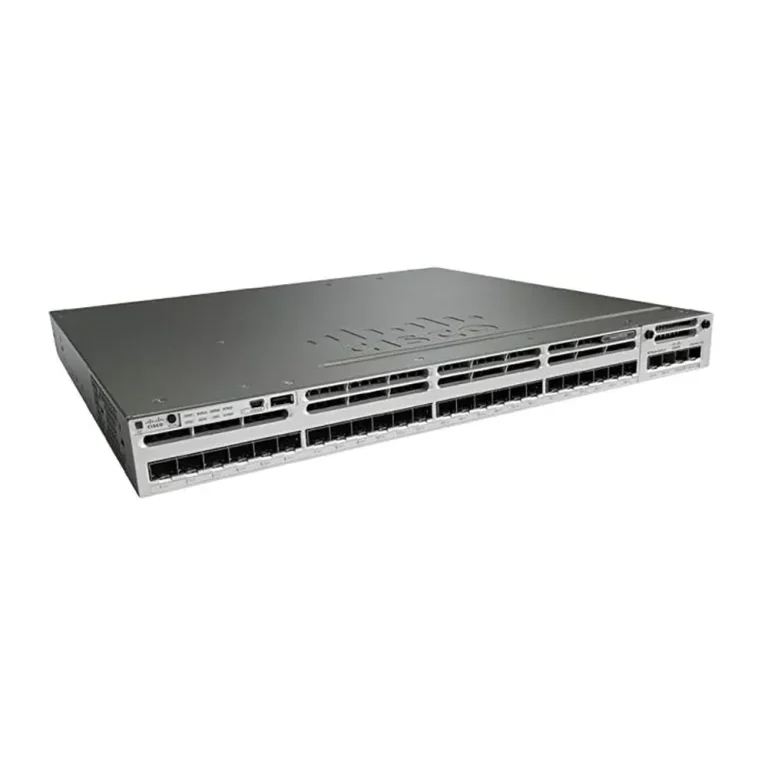 WS-C3850-24S-E
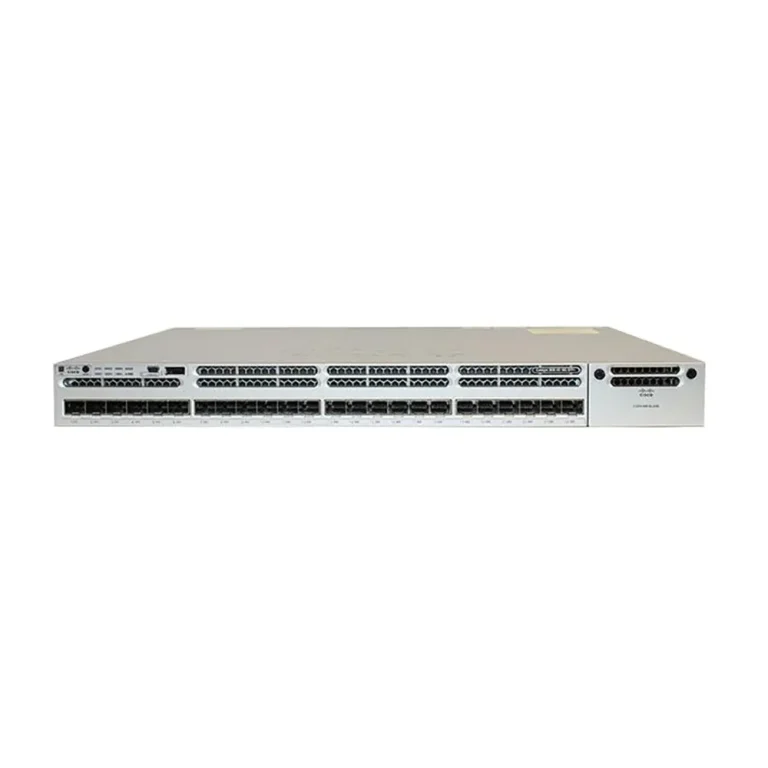 WS-C3850-24XS-E
Downlink density
| Model | Downlinks | What it consolidates |
|---|---|---|
| WS-C3850-12XS-E | 12 × SFP+ (10G) | Fewer, faster optical access uplinks — typical when closets already hand off 10G |
| WS-C3850-24S-E | 24 × SFP (1G) | More 1G fiber links from buildings or older optical access plants |
| WS-C3850-24XS-E | 24 × SFP+ class (related family) | Higher 10G density in the same Catalyst 3850 fiber family — confirm exact listing on quote |
Port count is not interchangeable with speed. Twenty-four 1G SFP ports do not replace twelve 10G SFP+ ports when the plant is already 10G.
Uplink / network module planning
Catalyst 3850 fiber models use a modular uplink path. The network module is part of the bill of materials — do not assume it is included or that every module fits every faceplate.
| PID | Uplink listed on catalog row | RFQ action |
|---|---|---|
| WS-C3850-12XS-E | C3850-NM-4-10G | Name C3850-NM-4-10G explicitly |
| WS-C3850-24S-E | C3850-NM-4-1G or C3850-NM-2-10G | Pick one module path and confirm optics |
Modules are orderable options on these rows. Confirm which module ships with or alongside the chassis on your quote response.
1G vs 10G fiber decision
| If southbound plant is… | Shortlist | Why |
|---|---|---|
| 10G SFP+ from access / building cores | WS-C3850-12XS-E (or denser 24XS family if needed) | Matches 10G optics end to end |
| 1G SFP fiber from older optical access | WS-C3850-24S-E | Matches 1G SFP density without forcing a 10G refresh mid-project |
| Copper PoE endpoints | Leave this guide | Wrong hardware class |
Switching capacity and forwarding
| Model | Capacity | Forwarding | Selection note |
|---|---|---|---|
| WS-C3850-12XS-E | 320 Gbps | 227.28 Mpps | Sized for 10G aggregation density on this listing |
| WS-C3850-24S-E | 92 Gbps | 68.4 Mpps | Sized for 1G fiber aggregation density on this listing |
Use these figures after the optic speed decision. Do not pick 12XS only because 320 Gbps is larger if the plant is still 1G SFP.
Stacking
Both shortlisted PIDs sit in the Catalyst 3850 stackable family. Authorized language on these rows points to StackWise-class stacking for fiber models — exact stack kit, cable, and member count must be confirmed on the quote.
- State whether the switch is a standalone member or joins an existing 3850 stack.
- Name stack cables / kit as separate line items when required.
- Do not assume Catalyst 9300 stack kits are drop-in compatible with 3850 stacks.
Software / feature set
The examples in this guide use -E (IP Services) PIDs: WS-C3850-12XS-E and WS-C3850-24S-E. IP Base (-S) variants exist in the broader Catalyst 3850 family when the design does not need the IP Services feature set.
- Quote -E when advanced Layer 3 / IP Services features are required by the campus design.
- Quote -S only when your design review confirms IP Base is sufficient.
- Do not mix feature-set assumptions across stack members without checking software compatibility.
Power / rack / physical
| Field | WS-C3850-12XS-E | WS-C3850-24S-E |
|---|---|---|
| PoE | Non-PoE | Non-PoE |
| PSU listed | PWR-C1-350WAC | PWR-C1-350WAC |
| Form | Fixed-port 1RU-class campus aggregation | Fixed-port 1RU-class campus aggregation |
Confirm redundant PSU needs, rail kit, and spare PWR-C1-350WAC on the RFQ when the design requires power redundancy. Dimensions and weight should be taken from the datasheet pages attached to the quote when rack drawings demand exact figures.
When Catalyst 9300 should be considered instead
Catalyst 3850 remains useful for refreshes that must stay on existing 3850 optics, stack kits, and operational playbooks. For new greenfield aggregation, also evaluate Catalyst 9300 fiber options when:
- You want a current campus stacking and software train.
- You are not locked to an existing 3850 stack.
- Longer support horizon matters more than matching the installed 3850 base.
Neither family is universally better. Match stack continuity, optic plant, and support window.
Product shortlist
| Model | Downlinks | Uplink listed | Capacity | Forwarding | PoE |
|---|---|---|---|---|---|
| WS-C3850-12XS-E | 12 × SFP+ | C3850-NM-4-10G | 320 Gbps | 227.28 Mpps | Non-PoE |
| WS-C3850-24S-E | 24 × SFP | C3850-NM-4-1G or C3850-NM-2-10G | 92 Gbps | 68.4 Mpps | Non-PoE |
| WS-C3850-24XS-E | 24 × SFP+ class | Confirm NM on quote | Confirm on listing | Confirm on listing | Non-PoE class |
Decision matrix
| Need | Shortlist |
|---|---|
| 12 × 10G SFP+ aggregation | WS-C3850-12XS-E |
| 24 × 1G SFP aggregation | WS-C3850-24S-E |
| Higher 10G density in the 3850 fiber family | WS-C3850-24XS-E — confirm exact ports/module |
| Stack requirement on existing 3850 | Stay on matching 3850 fiber PID + stack kit |
| IP Services feature set | Prefer -E PIDs in this guide |
| IP Base only | Ask for the matching -S PID — do not assume |
| Newer platform evaluation (greenfield) | Also evaluate Catalyst 9300 fiber options |
| PoE copper access | Leave this guide |
Common procurement mistakes
- Ordering 12XS when the optical plant is still 1G SFP.
- Ordering 24S when access uplinks are already 10G SFP+.
- Forgetting to name the network module (C3850-NM-…) on the RFQ.
- Mixing PoE copper access and fiber aggregation on one line item without labeling roles.
- Assuming stack cables and kits are included.
- Assuming -E and -S are interchangeable in the same stack without checking.
- Forcing a 3850 refresh when greenfield would be better served by evaluating Catalyst 9300 — or the reverse, forcing 9300 when the installed 3850 stack must continue.
FAQ
Do I need IP Services (-E) or IP Base (-S)?
Quote the feature set your routing design requires. This guide’s worked examples use -E (IP Services) PIDs. Ask for -S only when IP Base is confirmed sufficient.
Is the network module included?
Treat it as a named line item. WS-C3850-12XS-E lists C3850-NM-4-10G; WS-C3850-24S-E lists C3850-NM-4-1G or C3850-NM-2-10G — confirm which one ships on your quote.
Can I use these PIDs for PoE access?
No. Both shortlisted examples are Non-PoE fiber aggregation switches.
Should I always move to Catalyst 9300?
No. Refresh designs locked to 3850 stacks often stay on 3850. Greenfield designs should evaluate 9300 without treating either family as universally better.
Where is the 100G spine guide?
12XS-E vs 24S-E in one sentence?
12XS for 10G SFP+ southbound; 24S for 1G SFP southbound.