
This buying guide is for Catalyst 9200 24-port PoE+ campus/branch access closets where the open decision is modular C9200-24P-E versus fixed C9200L-24P-4G-E under Network Essentials.
Out of scope: Advantage (-A) designs, 48-port PoE rows, Catalyst 9300 greenfield replacements, and data-center 25G/100G leaves.
Buyer scope
- Endpoints need PoE+ (APs, phones, cameras).
- Access port count centers on 24 copper ports with growth spare capacity.
- Software can remain Network Essentials unless Advantage features are required.
- You must choose modular NM uplinks vs fixed 1G SFP.
Network architecture
Place these PIDs at the access layer. Keep default gateways and advanced routing on distribution/firewall unless operations has confirmed Essentials-scale routing on the access OS. Upstream links may be 1G SFP or 10G SFP+ depending on the modular NM choice — fixed C9200L stays on 1G SFP uplinks.
Access port planning
- Count powered and non-powered endpoints on day one.
- Add spare ports for growth (typical closet practice: leave headroom rather than filling all 24).
- If growth clearly exceeds 24 ports, leave this guide and evaluate 48P Catalyst rows separately.
PoE budget planning
Do not invent endpoint watts. Work from device class ratings:
- List each PoE endpoint and its power class / rated watts.
- Sum day-one demand.
- Add headroom for growth and worst-case simultaneous draw.
- Compare against the platform PoE budget for the planned PSU population (authorized modular C9200-24P-E listings commonly cite ~370 W with one 600 W PSU and up to ~740 W with dual 600 W supplies; C9200L listings describe a similar class envelope — confirm on the quote).
- Write the PSU SKU plan on the RFQ.
24 PoE+ ports ≠ 24 × 30 W available at once.
Physical hardware and media
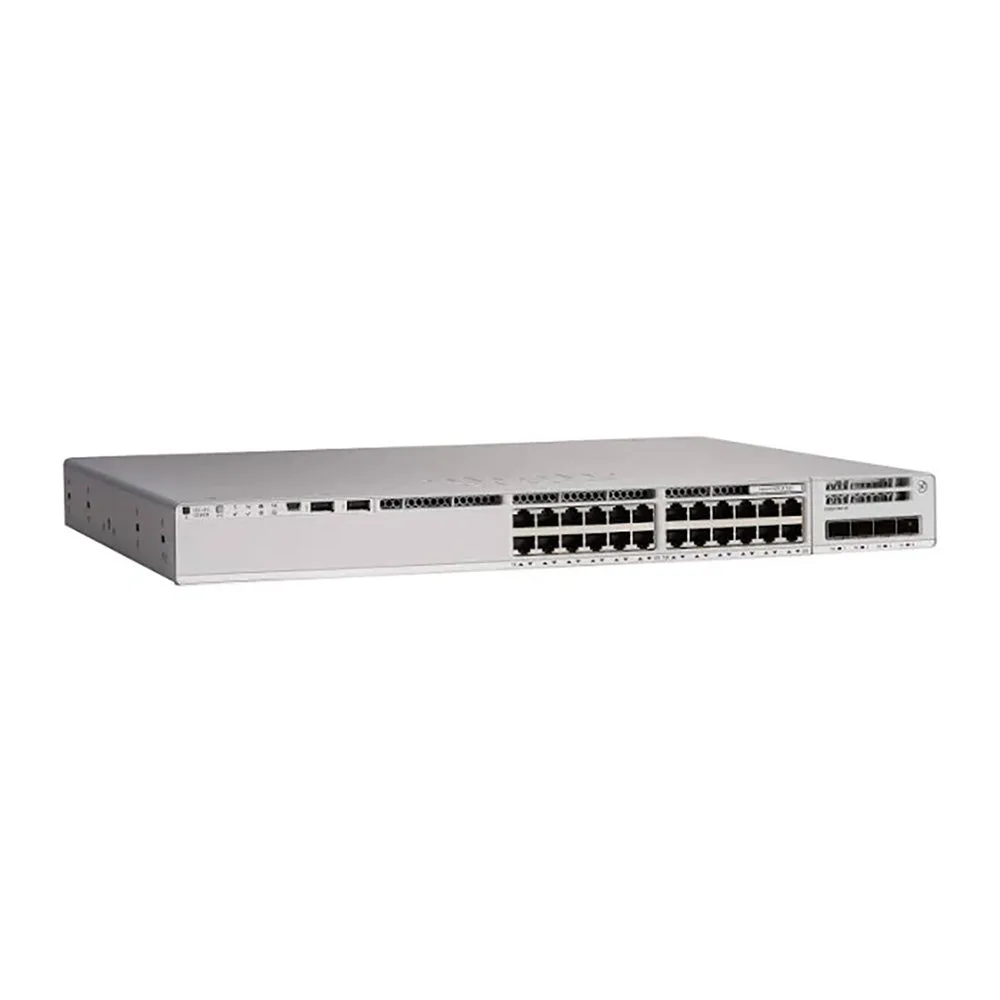
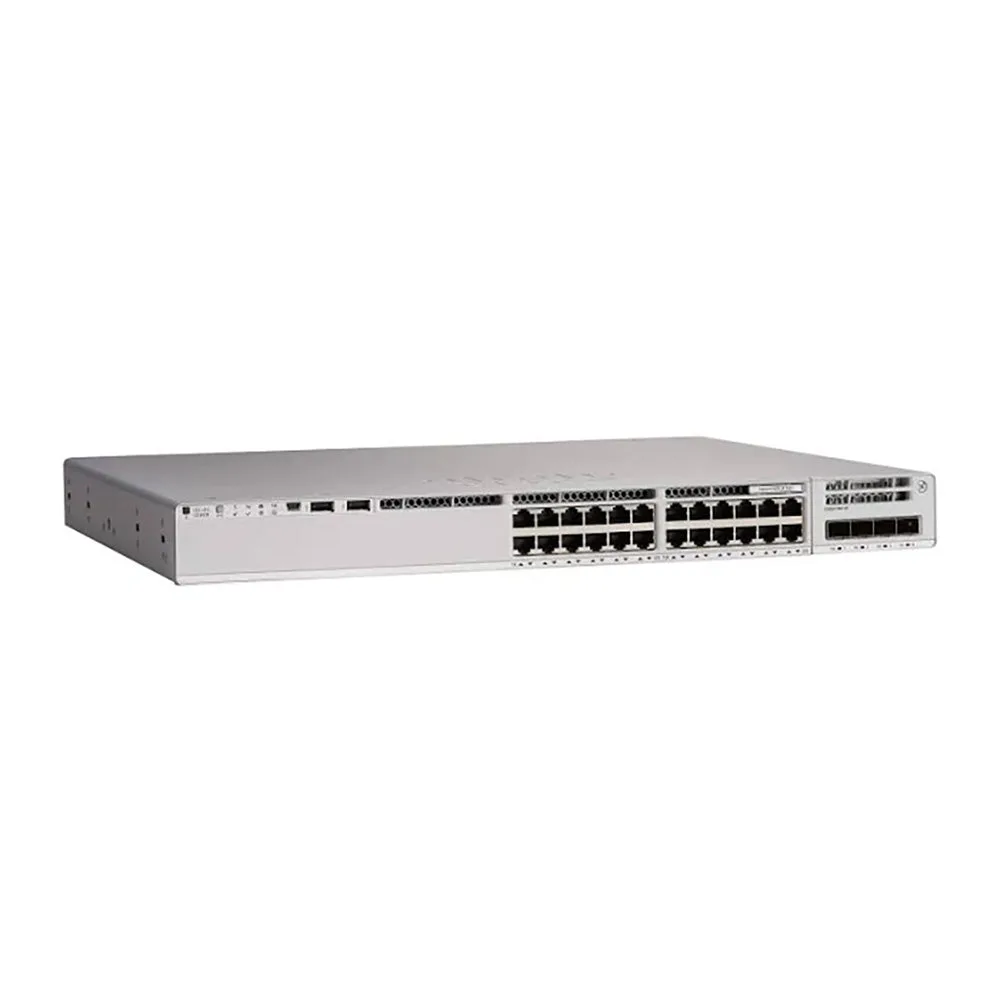
| PID | Access | Uplink | Capacity | Forwarding | Stacking |
|---|---|---|---|---|---|
| C9200-24P-E | 24 × 1G PoE+ | Modular NM-4G / NM-4X | 128 Gbps | 95.23 Mpps | StackWise-160 |
| C9200L-24P-4G-E | 24 × 1G PoE+ | Fixed 4 × 1G SFP | 56 Gbps | 41.66 Mpps | StackWise-80 class |
Uplink selection
- Modular C9200: name C9200-NM-4G or C9200-NM-4X (or the installed NM) on the RFQ. 10G NM options support future uplink growth.
- Fixed C9200L: accept four 1G SFP uplinks; plan optics accordingly.
- Confirm fiber vs copper SFP media and reach — optic choice is separate from the switch PID.
Stacking and redundancy
Decide stacking before purchase. Modular C9200 uses StackWise-160 with stack kit on authorized materials. C9200L uses StackWise-80 class stacking. Dual PSU plans affect PoE budget and redundancy — list them explicitly.
Software and licensing
- Network Essentials (-E) — foundational L2 plus limited L3 (static / OSPF scale limits on authorized Essentials descriptions).
- Network Advantage (-A) — required when Advantage features (for example advanced segmentation called out on Advantage SKUs) are in the design. Do not silently substitute -E.
See Catalyst 9200 L2/L3 notes.
Technical selection matrix
| Question | C9200-24P-E | C9200L-24P-4G-E |
|---|---|---|
| Need 10G uplink option later? | Yes via NM-4X class | No — fixed 1G SFP |
| Need StackWise-160? | Yes | No — 80-class |
| Prefer lower fixed-envelope cost when 1G uplinks suffice? | Usually no | Often yes |
| Essentials enough? | Yes on this shortlist | Yes on this shortlist |
Buyer decision workflow
- Confirm 24P PoE+ access is the right density.
- Confirm Essentials vs Advantage.
- Decide uplink: modular NM vs fixed 1G SFP.
- Run PoE watt math vs PSU plan.
- Decide stacking class and kit.
- Write exact PID + NM/optics on the RFQ.
Procurement mistakes
- Wrong PID / missing -E or -A letter.
- Wrong or missing NM on modular C9200.
- PoE watt budget ignored.
- Licensing mismatch (Essentials vs Advantage features).
- Stacking class mismatch.
- Optics omitted.
- Assuming dual PSU when only one is quoted.
FAQ
Can I use C9200-24P-E as a silent core?
No. It is an access PoE PID. Keep core/distribution on appropriate Catalyst 9500 / aggregation rows.
Is C9200L “worse”?
Not if fixed 1G uplinks match the design. It is a different hardware envelope with lower listed capacity (56 Gbps vs 128 Gbps on authorized data).
Do both support PoE+?
Yes — both shortlist rows list 24 × 1G PoE+. Confirm total watt budget vs PSU plan.
Where is the full comparison?
What about Layer 3 on Essentials?
Keep gateways upstream unless Essentials-scale routing is confirmed. Advantage features need matching -A PIDs.