Use this guide when the missing switch sits above access closets and speaks 10G fiber. It is not a server-leaf guide and not a PoE closet guide.
If the devices on the other end are servers, use the leaf buying guide. If they are powered phones and APs, stay on PoE switches.
What 10G aggregation is for
Aggregation collects uplinks from access switches and forwards them toward the core or WAN. The buying questions are access-uplink speed, northbound speed, and whether the platform stacks. PoE budget is usually the wrong question.
Example models
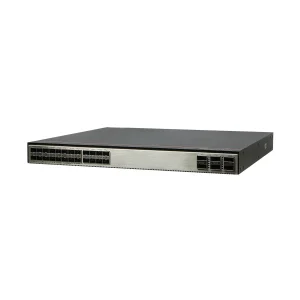 S6730-H24X6C
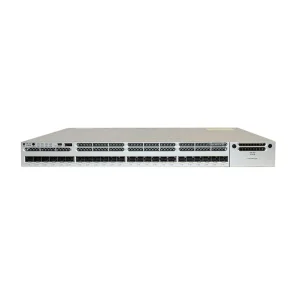 WS-C3850-24XS-E
Faceplate
Downlinks
Count real SFP+ ports, not marketing family names. S6730-H24X6C and WS-C3850-24XS-E both list 24 × 10G downlinks, but the uplink hardware differs.
Uplinks
S6730-H24X6C lists 6 × 40/100GE QSFP28. WS-C3850-24XS-E lists a network-module slot, with C3850-NM-4-1G and C3850-NM-2-10G as examples. Quote the module; do not leave it implied.
Planning
Capacity
Use the figure on the PID. S6730-H24X6C lists up to 2.4 Tbps and 490 Mpps. WS-C3850-24XS-E lists 320 Gbps and 454.55 Mpps. Do not average them.
Stacking
iStack is listed on S6730-H24X6C. The 3850 record allows up to 9 members with the same IOS feature set in the same series. State the member count in the RFQ.
What not to mix in
CE6820 and CE6885 are data-center faceplates. RG-S6980-128DC is a 200GE fabric switch. Keep them off this shortlist unless the design changed.
Grounded comparison
| Model | 10G ports | Uplink | Capacity | PoE |
|---|---|---|---|---|
| S6730-H24X6C | 24 × 10GE SFP+ | 6 × 40/100GE QSFP28 | Up to 2.4 Tbps | Non-PoE |
| WS-C3850-24XS-E | 24 × SFP+ | Network module slot | 320 Gbps | Non-PoE |
Questions before the quote
- How many access switches uplink at 10G?
- Is the northbound link 10G, 40G, or 100G?
- Is a stack required, and of what size?
- Which network module, if the PID uses one?
- Is anyone still asking for PoE on this layer?